Are Folding E‑Scooters Allowed on Trains and Subways? The Complete Guide to Rules, Restrictions & Tips
Introduction
Urban commuters are increasingly turning to folding electric scooters as a flexible last‑mile solution. This guide explains the regulatory landscape that governs the carriage of such devices on trains and subway systems. Readers will learn how to interpret agency policies, avoid common penalties, and select a scooter that complies with the most stringent requirements.
The article also integrates three highly rated models that exemplify best‑in‑class performance, safety and portability. By the end of the guide, commuters will possess a clear roadmap for travelling with a scooter while respecting the rules of each transit authority.
Background and Context
Public transit agencies define their own policies regarding personal mobility devices. These policies typically address safety, space utilisation, and the potential impact on other passengers. In many jurisdictions, the primary concerns are battery certification, weight limits, and the ability to fold the scooter quickly.
Regulatory bodies such as the Federal Transit Administration in the United States and the European Union’s Technical Specifications for Interoperability provide baseline safety standards. Most agencies require that the scooter be fully folded, have a maximum length of approximately 42 inches, and possess a UL2272 or equivalent certification for the battery system.
Understanding these baseline requirements helps commuters anticipate which models will be accepted across multiple networks. The following sections break down the rules by region and by transit mode.
Key Regulations by Transit Mode
National Rail Services
National rail operators generally allow folding e‑scooters provided the device is stored in a designated luggage area or a personal space that does not obstruct aisles. The scooter must be turned off, and the battery must be certified under UL2272. Some operators impose a weight ceiling of 30 kg, which aligns with the specifications of many consumer‑grade scooters.
Passengers are advised to board during off‑peak hours when possible, as crowding can lead to stricter enforcement. Failure to comply may result in a fine of up to $150 or removal of the scooter from the train.
Urban Metro and Subway Systems
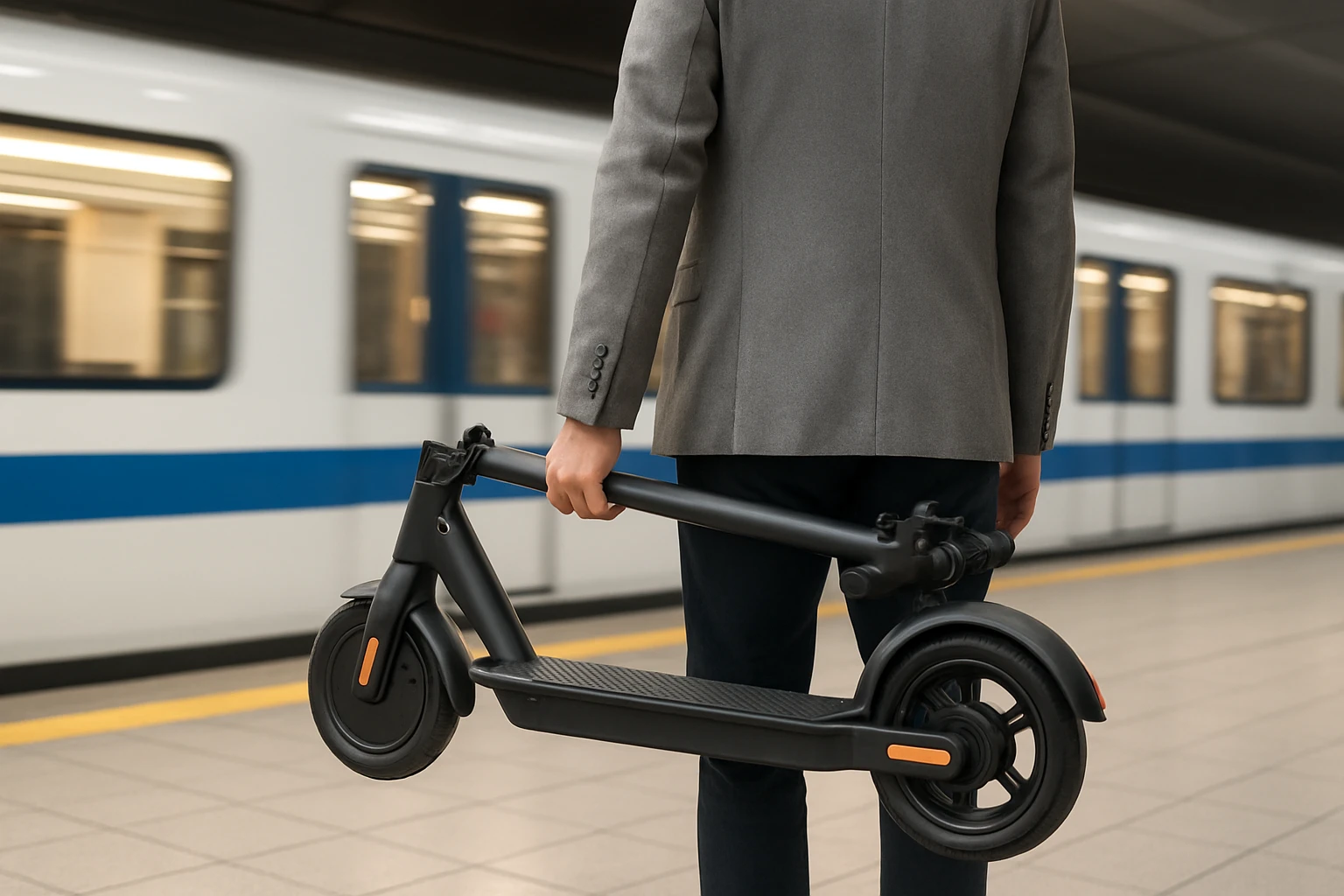
Metro systems often have more restrictive policies due to limited platform space. Most agencies require that the scooter be folded and stored in a personal bag or a small compartment. In cities such as London, the maximum folded length is 42 inches and the width must not exceed 12 inches.
Battery certification remains a non‑negotiable requirement. Some subway operators also prohibit scooters during peak hours to minimise congestion. Riders should consult the official website of the local transit authority before travel.
Light Rail and Commuter Trains
Light rail networks tend to adopt a hybrid approach, allowing scooters on board if they are folded and placed on the floor near the doors. The weight limit is often 25 kg, and the scooter must be turned off throughout the journey.
Operators may request that riders hold the scooter securely to prevent it from rolling. In certain jurisdictions, a small surcharge is levied for transporting a personal mobility device.
Product Recommendations Integrated with Regulations
When selecting a scooter for multimodal travel, three criteria dominate: compact folded size, lightweight construction, and UL2272 battery certification. The following products meet these criteria and have received strong user feedback.
OBX 500W Electric Scooter
The OBX 500W Electric Scooter offers a robust 500 W peak motor capable of 18 mph top speed, yet it folds to a length of 41 inches and weighs only 28 lb. Its 36 V/7.8 Ah battery holds UL2272 certification, satisfying the safety requirements of most rail operators. The solid 8.5‑inch honeycomb tire eliminates puncture risk, a valuable feature for commuters who may encounter uneven platform surfaces.
With a range of 12‑18 miles per charge, the scooter is well suited for short‑distance commutes that combine train travel with a brief final leg. The dual braking system, consisting of an electronic front brake and rear disc brake, enhances safety during sudden stops on crowded platforms.
Roinside Foldable Electric Scooter
The Roinside Foldable Electric Scooter features a 350 W brushless hub motor and a maximum speed of 19 mph. Its folded dimensions are comparable to the OBX model, and it weighs 30 lb, making it portable for stair‑wells and tight subway carriages. The scooter includes a high‑capacity 5.2 Ah battery, providing up to 16 miles of range, and it complies with UL2272 safety standards.
Additional safety features include a dual braking system and bright LED headlights, which are useful for night‑time station navigation. The aluminium alloy frame supports riders up to 265 lb, offering flexibility for a broad user base.
Gotrax GXL V2 Electric Scooter
The Gotrax GXL V2 Electric Scooter is a classic model that balances performance and portability. It folds to a compact size of 43.7 × 17.3 × 16.1 inches and weighs 27 lb, meeting most subway length restrictions. The scooter is equipped with a UL2272‑certified 36 V 5.2 Ah battery, delivering a range of up to 12 miles and a top speed of 15.5 mph.
Its solid 8.5‑inch honeycomb tire eliminates the need for maintenance, and the large console provides clear battery and speed readouts. The GXL V2’s sturdy aluminium frame supports up to 220 lb, making it a reliable option for everyday commuters.
Comparison and Selection Guide
| Feature | OBX 500W | Roinside | Gotrax GXL V2 |
|---|---|---|---|
| Motor Power | 500 W peak | 350 W | 250 W |
| Top Speed | 18 mph | 19 mph | 15.5 mph |
| Range per Charge | 12‑18 miles | Up to 16 miles | Up to 12 miles |
| Weight (lb) | 28 | 30 | 27 |
| Folded Length (in) | 41 | ≈42 | 43.7 |
| Max Load | 264 lb | 265 lb | 220 lb |
| Battery Certification | UL2272 | UL2272 | UL2272 |
| Average Rating | 4.0/5 (22 reviews) | 4.6/5 (329 reviews) | 4.3/5 (3,491 reviews) |
Commuters who prioritise speed and hill‑climbing capability may prefer the OBX 500W model. Those who value a higher load capacity and a slightly longer range might select the Roinside scooter. Riders seeking a proven, widely reviewed platform with a modest weight may find the Gotrax GXL V2 to be the optimal choice.
Best Practices and Tips for Riding on Trains and Subways
- Always fold the scooter completely before boarding. Verify that the folded length complies with the specific transit authority’s limits.
- Turn off the motor and disconnect any active lights to prevent accidental activation while the vehicle is in motion.
- Store the scooter in a personal bag, under a seat, or in a designated luggage area. Do not block aisles, doors, or emergency exits.
- Carry a portable charger or spare battery if the journey exceeds the scooter’s advertised range. This avoids the need for unscheduled charging on platform benches.
- Respect peak‑hour restrictions. If an operator prohibits scooters during rush hour, plan travel outside those windows or consider alternative modes.
- Maintain a copy of the scooter’s UL2272 certification in case a transit employee requests proof of compliance.
Frequently Asked Questions
Can I bring a folding e‑scooter on any train in the United States?
Most Amtrak routes permit folded e‑scooters, but each state‑owned commuter rail may have its own policy. It is essential to review the specific carrier’s website before travel.
Do subway systems require a special permit for e‑scooters?
Generally, no permit is required if the scooter meets size, weight, and certification criteria. However, some cities issue a temporary pass for large‑scale events.
What battery certification should I look for?
The UL2272 certification is widely recognised as the safety standard for lithium‑ion batteries in personal mobility devices. Ensure that the scooter’s documentation explicitly references this certification.
Are there any penalties for violating scooter rules on public transit?
Penalties vary by agency but can include fines ranging from $50 to $200, removal of the scooter, or denial of boarding. Repeated violations may result in a ban from the service.
How can I protect my scooter from theft while on a train?
Use a lockable bag or a cable lock that secures the scooter to a fixed anchor point. Many transit stations provide designated luggage racks for this purpose.
Conclusion
Folding electric scooters provide a versatile solution for the last‑mile segment of urban travel, but successful integration with train and subway systems depends on compliance with size, weight, and safety regulations. By selecting a scooter that meets UL2272 certification, folds within the permitted dimensions, and respects the policies of each transit authority, commuters can enjoy a seamless multimodal journey.
The three models highlighted in this guide—OBX 500W Electric Scooter, Roinside Foldable Electric Scooter, and Gotrax GXL V2 Electric Scooter—offer a range of performance levels to match diverse commuter needs. Applying the best‑practice tips and adhering to local regulations will ensure a safe and efficient travel experience.
Products Featured in This Guide
OBX 500W Electric Scooter
Price: $98.99
Rating: 4.0 out of 5 (22 reviews)
Featured because it combines a powerful motor, UL2272‑certified battery, and a compact folded size that satisfies most train and subway regulations.
Roinside Foldable Electric Scooter
Price: $159.99
Rating: 4.6 out of 5 (329 reviews)
Featured because it offers a high‑capacity battery, dual‑brake safety system, and a sturdy aluminium frame that meets the weight and size limits of most urban transit networks.
Gotrax GXL V2 Electric Scooter
Price: $299.00
Rating: 4.3 out of 5 (3,491 reviews)
Featured because it is a widely reviewed, UL2272‑certified model with a compact fold and solid tire, making it a reliable choice for commuters who travel frequently on crowded subway lines.