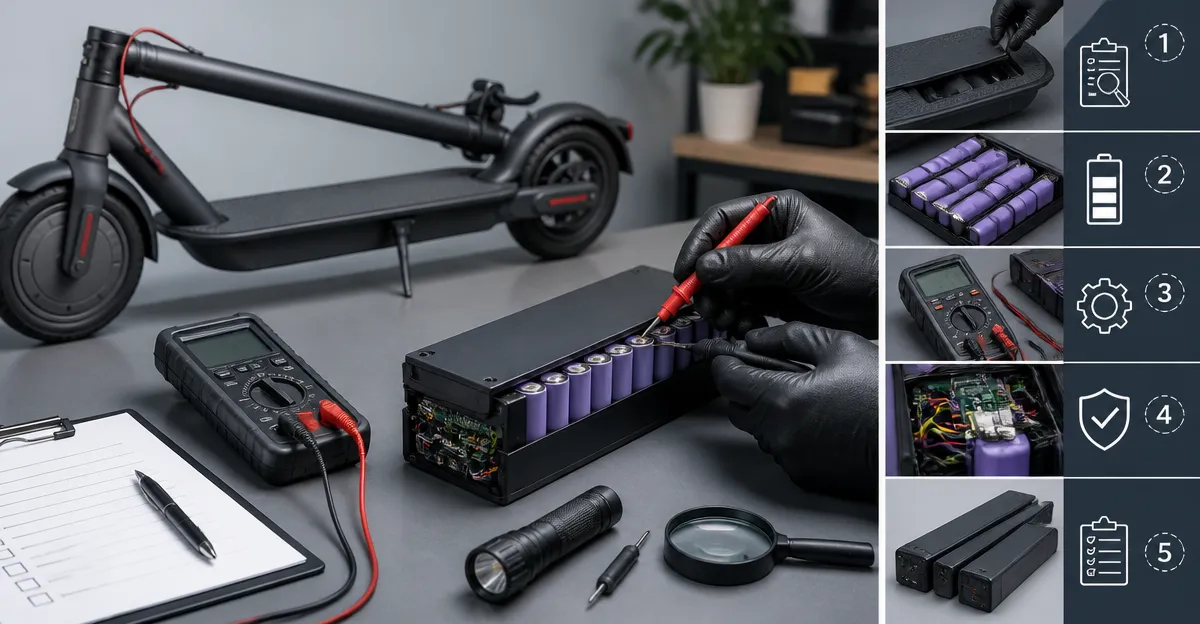
How to Grade a Used Folding E‑Scooter Battery: Step‑by‑Step Inspection & Checklist for Buyers
The purpose of this guide is to enable a prospective buyer to evaluate a used folding e‑scooter battery with confidence. One will learn how to perform a visual examination, verify electrical performance, assess safety features, and assign a grade that reflects remaining life and reliability. By following a systematic approach, one reduces the risk of purchasing a battery that will fail prematurely, thereby protecting both financial investment and rider safety.
What You'll Need
- Digital multimeter capable of measuring DC voltage and resistance.
- Battery charger compatible with 36 V lithium‑ion packs.
- Protective gloves and safety glasses.
- Clean workspace with non‑conductive surface.
- Replacement battery options for later reference:
CWUU 36V 8.5Ah Scooter Battery, VATOSO 36V 7.8Ah Battery, and CWUU 36V 7.8Ah Scooter Replacement Battery.
Step 1: Visual Inspection
The first step is to examine the external condition of the battery pack. One should look for swelling, dents, corrosion on terminals, and any signs of water ingress. Swelling indicates internal cell degradation and should result in a failing grade. Corroded terminals can cause poor contact and safety hazards; they may be cleaned but also suggest neglect.
During this inspection, verify that all connectors match the description of the original battery. The CWUU 36V 8.5Ah Scooter Battery includes XT60, XT30, JST, and SM2P connectors, providing a comprehensive kit for various scooter models. Having the correct connectors simplifies replacement and reduces the need for custom wiring.
Step 2: Verify Voltage with a Multimeter
Measure the open‑circuit voltage (OCV) of the battery while it is disconnected from any load. A healthy 36 V lithium‑ion pack should read between 42 V (fully charged) and 36 V (nominal). Readings below 34 V suggest significant capacity loss and warrant a lower grade.
If the voltage is within the acceptable range, proceed to the load test. If the voltage is excessively high, the battery may have been overcharged, which can compromise safety. The VATOSO 36V 7.8Ah Battery features a built‑in 30 A BMS that protects against over‑voltage, making it a reliable replacement for users who prioritize safety.
Step 3: Capacity Test (Load Test)
Connect the battery to its intended charger and allow it to reach full charge. Then, discharge the battery at a controlled current that reflects typical scooter usage (approximately 10 A for a 300 W motor). Record the time required to reach the cutoff voltage of 36 V. Multiply the discharge current by the discharge time (in hours) to estimate the effective capacity in amp‑hours.
Compare the measured capacity with the manufacturer's rating. The CWUU 36V 8.5Ah Scooter Battery advertises 8.5 Ah; a result above 7 Ah is considered good, while below 5 Ah indicates a battery nearing end‑of‑life. The CWUU 36V 7.8Ah Scooter Replacement Battery provides a similar capacity of 7.8 Ah and includes XT60 female and SM male connectors for plug‑and‑play installation, which can be advantageous for quick swaps.
Step 4: Assess Battery Management System (BMS) Functionality
Modern lithium‑ion packs incorporate a BMS to protect against over‑charge, over‑discharge, short‑circuit, and temperature extremes. To evaluate the BMS, attempt a rapid charge using the supplied charger and observe whether the battery accepts the charge without triggering an error. Additionally, check for Bluetooth connectivity if the pack offers it; the CWUU 36V 8.5Ah Scooter Battery includes a Bluetooth function that displays real‑time charge level, aiding in ongoing monitoring.
Any abnormal shutdowns or inability to charge suggest a faulty BMS, which reduces the grade substantially. The VATOSO battery’s 30 A BMS provides six layers of protection, including cell‑balance monitoring, which is a strong selling point for users who perform frequent DIY modifications.
Step 5: Confirm Connector Compatibility and Physical Fit
Measure the dimensions of the battery and compare them with the original pack specifications. The CWUU 36V 8.5Ah Battery measures 11.42 × 2.76 × 1.38 inches, while the CWUU 36V 7.8Ah Replacement measures 11.41 × 2.75 × 1.37 inches. Both dimensions fit most standard folding e‑scooters, but one must verify the mounting space before purchase.
Inspect the connector type on the used battery. If the original uses an XT60 plug, the CWUU 36V 8.5Ah Battery provides pre‑tinned XT60 and XT30 male connectors, reducing the need for additional adapters. The VATOSO battery also supplies an XT60 discharge connector and an SM charging connector, making it suitable for a wide range of 36 V scooters and DIY projects.
Step 6: Assign a Grade
Based on the findings from the previous steps, assign a grade using the following scale:
- A (Excellent): No swelling, OCV 40‑42 V, capacity ≥ 90 % of rated, BMS fully functional, connectors intact.
- B (Good): Minor cosmetic issues, OCV 38‑40 V, capacity 75‑90 % of rated, BMS works, connectors compatible.
- C (Fair): Visible swelling or corrosion, OCV 36‑38 V, capacity 50‑75 % of rated, BMS intermittent, may require replacement.
- D (Poor): Significant swelling, OCV < 36 V, capacity < 50 % of rated, BMS fails, unsafe for continued use.
Document the grade alongside photographs and test data. This record assists sellers and buyers in negotiating price and establishing trust.
Tips & Pro Tips
- Always wear protective gloves and glasses when handling lithium‑ion cells.
- Perform the capacity test in a well‑ventilated area to avoid accumulation of gases.
- Use a temperature‑controlled environment; extreme cold or heat can skew voltage readings.
- When a battery fails the BMS test, consider replacing it with a pack that includes an advanced BMS, such as the VATOSO 36V 7.8Ah Battery, which offers over‑temperature and cell‑balance protection.
- Record the serial number of the battery; manufacturers sometimes provide warranty extensions based on usage logs.
Troubleshooting
Problem: Battery does not charge past 38 V.
Solution: Verify that the charger output matches the battery specification and inspect the charging connectors for damage. If the BMS is preventing charge acceptance, a replacement pack with a more robust BMS (e.g., VATOSO) may be required.
Problem: Sudden voltage drop during load test.
Solution: This symptom often indicates cell imbalance. The built‑in cell‑balance feature of the VATOSO battery can mitigate this issue, but for the tested pack, consider a professional re‑balancing service or replacement.
Conclusion
By following the systematic inspection, electrical testing, and safety assessment outlined in this guide, one can reliably grade a used folding e‑scooter battery. The process protects the buyer from hidden defects, ensures compatibility with the scooter, and highlights when a replacement such as the CWUU 36V 8.5Ah Scooter Battery or the VATOSO 36V 7.8Ah Battery is the most appropriate solution. A well‑graded battery extends the lifespan of the scooter and contributes to a safer riding experience.
Products Mentioned in This Guide
Frequently Asked Questions
How can I visually inspect a used folding e‑scooter battery for damage?
Look for swollen cells, corrosion, cracked casings, loose connections, and any signs of leakage or burn marks.
What voltage reading indicates a healthy 36 V lithium‑ion battery at rest?
A fully charged 36 V pack should read between 42.0 V and 42.5 V; around 38‑39 V suggests moderate wear.
How do I test the battery’s capacity with a multimeter?
Measure the voltage under load and then calculate the discharge time to a safe cutoff, comparing the result to the original Ah rating.
Which safety precautions should I take when grading a used battery?
Wear protective gloves and glasses, work on a non‑conductive surface, and avoid short‑circuiting the terminals.
How is the grading scale determined and what does each grade mean?
Grades (A‑E) reflect remaining capacity, cycle count, and physical condition; A is like new, B‑good, C‑fair, D‑poor, and E‑unusable.