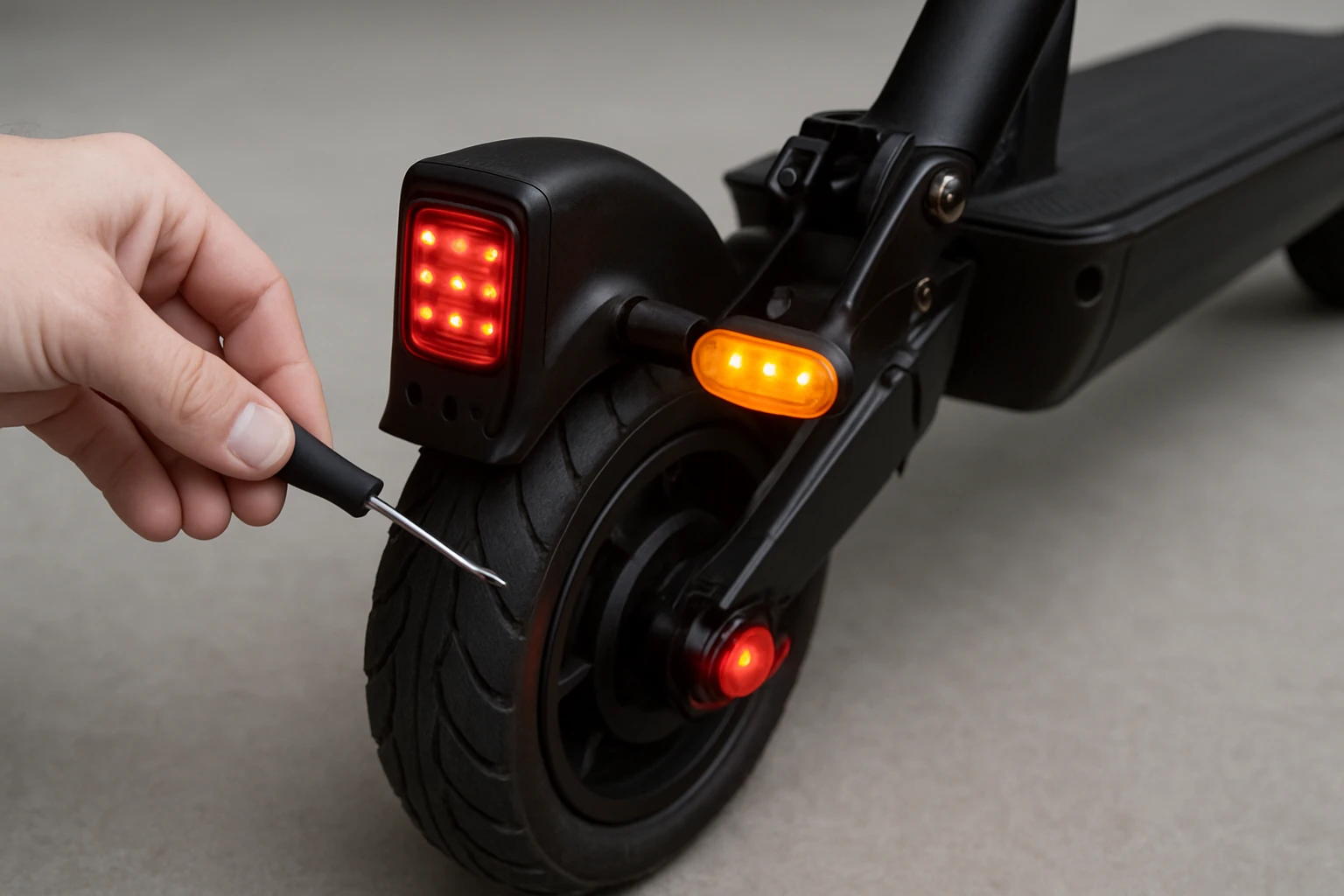
How to Upgrade Lights and Safety Features on Your Folding Scooter: DIY LED, Brake‑Light & Reflector Install for Safer Night Riding
Introduction
Night riding on a folding scooter can be enjoyable, yet it presents unique safety challenges that demand reliable illumination and clear signaling. This guide will teach the reader how to select appropriate lighting components, install a rear LED tail light, add a brake‑light with reflector capability, and integrate a wireless turn‑signal system. By following the procedures, one can dramatically increase visibility to motorists and pedestrians, thereby reducing the risk of accidents. The information is presented in a professional tone and is designed for an intermediate audience that possesses basic mechanical skills.
What You Will Need
- Generic Electric Scooter Rear Tail Light – a weather‑proof LED unit designed for Ninebot MAX G30 models.
- Yosoo Universal Motorcycle LED Tail Light – a dual‑function brake and turn‑signal lamp suitable for many scooter frames.
- FXINRUIA E‑Scooter Turn Signal with Remote – a wireless, multi‑mode signal system compatible with Xiaomi and Ninebot series.
- Phillips screwdriver set, hex key set, and small pliers.
- Electrical tape, heat‑shrink tubing, and a portable soldering iron (optional for secure connections).
- Cleaning cloth and isopropyl alcohol for surface preparation.
Step 1: Prepare the Scooter Frame
Begin by placing the scooter on a stable work surface, ensuring that the wheels are locked to prevent movement. Use a cleaning cloth dampened with isopropyl alcohol to remove dust, grease, and debris from the rear fender and the mounting area where the new lights will be installed. Inspect the existing wiring harness for signs of wear; replace any frayed sections before proceeding. This preparation step creates a clean environment that promotes strong adhesion of the new components.
Step 2: Install the Rear LED Tail Light
Locate the factory tail‑light socket on the rear of the scooter; it is typically a small plug that slides into a recessed cavity. Disconnect the original unit by gently pulling the connector while supporting the housing. Align the Generic Electric Scooter Rear Tail Light with the socket, ensuring that the plug orientation matches the original configuration. Insert the plug fully and secure the unit with the two supplied screws and the buckle provided in the package.
The selected tail light offers a waterproof construction, a 5‑watt LED module, and a bright red lens that enhances visibility in rain or fog. Its compatibility with the Ninebot MAX G30 model eliminates the need for adapters, reducing installation time. The unit is priced at $8.99 and carries a 4‑star rating based on six reviews, indicating satisfactory performance for most users.
Step 3: Add a Dual‑Function Brake Light
Many folding scooters lack a dedicated brake‑light, which can lead to delayed reactions from following traffic. The Yosoo Universal Motorcycle LED Tail Light provides both brake illumination and a turn‑signal function, making it an efficient upgrade. Position the unit on the rear fender where the original reflector was located, ensuring that the light faces directly backward for maximum effect.
Secure the lamp using the mounting brackets that accompany the product; these brackets are designed to fit a wide range of scooter diameters. Connect the power leads to the scooter’s battery line, observing polarity markings to avoid reverse polarity. The lamp draws low power, preserving battery life while delivering high brightness through its 24 SMD LEDs. Priced at $6.74 with a 4.3‑star rating from 94 reviews, this lamp offers excellent value for riders seeking enhanced safety.
Step 4: Integrate a Wireless Turn‑Signal System
Effective signaling during lane changes is essential for preventing collisions, especially on busy urban streets. The FXINRUIA E‑Scooter Turn Signal with Remote utilizes a wireless remote to control left and right signals, eliminating the need for complex wiring. Begin by attaching the signal modules to the scooter’s fender using the provided screw mounts; the mounts are engineered to resist vibration and will not detach during normal riding.
After mounting, power the units by connecting them to the scooter’s 5‑V line, using heat‑shrink tubing to insulate the connections. Pair the remote with the modules by following the manufacturer’s instructions; this typically involves holding the remote button until the LEDs flash in a synchronized pattern. The system includes a high‑sound horn that activates when a turn is signaled, alerting nearby pedestrians. At $18.99 and a 4‑star rating from 231 reviews, this product provides a comprehensive signaling solution for a modest investment.
Step 5: Test All Lighting Functions
Before returning the scooter to regular use, verify that each lighting component operates correctly. Activate the rear LED tail light by turning the scooter on; the light should illuminate steadily. Apply the brakes to confirm that the Yosoo brake light flashes or remains solid, depending on the selected mode. Use the remote to trigger left and right turn signals, ensuring that the corresponding LEDs flash and the horn sounds as expected.
If any component fails to respond, re‑examine the wiring connections for secure contact and proper insulation. Use a multimeter to check voltage levels at each connector, confirming that the power supply meets the specifications listed in the product manuals. Addressing issues at this stage prevents unsafe riding conditions later.
Tips & Pro Tips
- Apply a thin layer of silicone sealant around the mounting screws of the tail lights to enhance water resistance.
- When routing wires, keep them away from moving parts such as the brake lever and suspension pivots to avoid abrasion.
- Consider using a rechargeable lithium‑ion battery pack with a higher amp‑hour rating if the added lights significantly increase power draw.
- For riders who frequently commute in heavy traffic, enable the high‑brightness mode of the turn‑signal system during peak hours for maximum visibility.
Troubleshooting
Problem: Tail light remains dim or does not turn on.
Solution: Verify that the connector is fully seated and that the scooter’s main power switch is engaged. Inspect the LED module for damage; replace the unit if the LED chip appears burnt.
Problem: Turn signal remote does not communicate with the modules.
Solution: Reset the pairing by turning the scooter off, removing the battery for ten seconds, and then re‑pairing according to the manufacturer’s guide. Ensure that no metal objects interfere with the wireless signal.
Conclusion
Upgrading a folding scooter with a rear LED tail light, a dual‑function brake light, and a wireless turn‑signal system dramatically improves nighttime visibility and overall safety. The guide has detailed each installation step, highlighted why the recommended products are well suited for the task, and offered practical tips to ensure long‑term reliability. By following these instructions, the rider can enjoy confident night riding while adhering to road safety standards.
Products Mentioned in This Guide
Frequently Asked Questions
What type of LED tail light is best for a folding scooter?
Choose a weather‑proof, 5‑V or 12‑V LED tail light that matches your scooter's voltage and can be mounted to the rear frame without drilling.
Can I add a brake‑light to an existing scooter tail light?
Yes, many universal tail lights like the Yosoo model have a dual‑function mode that lights up brighter when the brake lever is engaged.
How do I install a wireless turn‑signal system on a folding scooter?
Attach the small transmitter to the handlebars, pair it with the receiver mounted near the rear light, and configure the turn‑signal mode via the included remote.
Will adding lights drain my scooter’s battery quickly?
LED lights draw only a few milliamps, so the impact on range is minimal—typically less than 5% of total battery capacity per hour of use.
Do I need to modify the scooter frame to mount new lights?
Most aftermarket lights come with adhesive pads or zip‑tie mounts, allowing installation without permanent frame modifications.