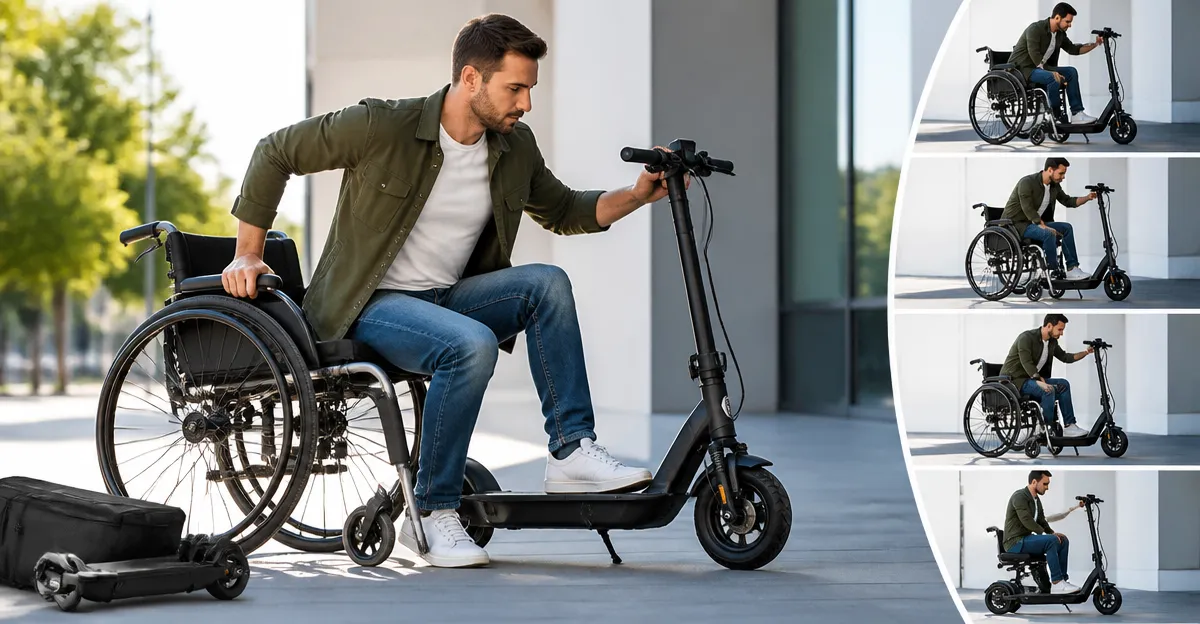
How to Transfer Safely from a Wheelchair to a Folding E‑Scooter: Step‑by‑Step Guide for Wheelchair Users
Introduction
This guide explains how an individual who uses a wheelchair can move confidently onto a folding electric scooter. It outlines the preparatory steps, the physical techniques, and the safety equipment required for a smooth transfer. Readers will learn how to evaluate personal needs, select an appropriate scooter, and practice the transfer process until it becomes routine. The information presented combines clinical best practices with real‑world product examples.
Background and Context
Mobility scooters and folding e‑scooters have become popular alternatives for short‑range travel because they are lightweight, portable, and often eligible for health‑savings accounts. For wheelchair users, the transition to a scooter can increase independence while reducing the physical strain of pushing a manual wheelchair over long distances. However, the transfer itself poses challenges related to balance, grip strength, and environmental obstacles. Understanding the biomechanics of a transfer and the specifications of the scooter helps to mitigate risk.
Assessing Readiness for Transfer
Before attempting any transfer, an individual should obtain clearance from a healthcare professional, especially if balance or upper‑body strength is limited. A simple assessment includes measuring the ability to lift the legs onto a seat that is at least 2‑3 inches higher than the wheelchair seat. The user should also be able to reach the scooter’s handlebars without over‑extending the shoulders. If these criteria are met, the next step is to choose a scooter that matches the user’s weight capacity, speed preferences, and folding dimensions.
Choosing the Right Folding Scooter
Four key attributes influence the suitability of a folding scooter for wheelchair users: weight capacity, motor power, folding mechanism, and accessory support. The table below compares the five products highlighted in this guide against those attributes.
| Product | Capacity | Motor Power | Folded Size | Price (USD) | Rating |
|---|---|---|---|---|---|
| IQIRAF Foldable Mobility Scooter | 330 lbs | 300 W | Compact (exact dimensions not disclosed) | 299.99 | 4.3/5 (91 reviews) |
| Rylox Foldable Mobility Scooter | 330 lbs | 250 W | 40" × 19" × 14" | 319.99 | 4.4/5 (236 reviews) |
| Sugogo Lightweight Mobility Scooter | 300 lbs | 270 W | 38" × 20" × 13.5" | 599.99 | 4.8/5 (65 reviews) |
| HOMEVOL Heavy Duty Mobility Scooter | 400 lbs | 450 W | Not specified, but folds easily | 759.97 | 4.8/5 (137 reviews) |
| Hiboy S2 Electric Scooter | 250 lbs (manufacturer limit) | 350 W | Folded height ~30" | 299.99 | 4.2/5 (2,529 reviews) |
For most wheelchair users, a capacity of at least 300 lbs provides a safety margin for the user plus any accessories. The IQIRAF and Rylox models meet this requirement while remaining under $320, making them cost‑effective choices. The HOMEVOL model offers the highest capacity and motor power, suitable for users who need extra torque on inclines. The Hiboy S2, although technically an electric scooter rather than a mobility scooter, is included for users who prefer a lighter, more compact device for urban commuting.
Preparing the Transfer Environment
Safety begins with a well‑organized environment. The scooter should be positioned on a level surface with the brakes engaged and the steering locked if the model provides a lock. Remove any obstacles such as loose rugs, cords, or uneven thresholds that could cause a slip. Ideally, the scooter’s seat height should be adjusted so that the user’s hips are slightly higher than the wheelchair seat, reducing the effort required to lift the legs.
Step‑by‑Step Transfer Technique
Step 1 – Position the Wheelchair and Scooter. Align the wheelchair parallel to the scooter, leaving a gap of approximately 6‑8 inches between the two seats. This distance allows the user to slide the legs across without excessive twisting.
Step 2 – Secure the Scooter. Engage the electromagnetic brake (available on the IQIRAF, Rylox, Sugogo, and HOMEVOL models) and verify that the scooter will not roll forward. Some models also feature a built‑in key system that prevents accidental start‑up.
Step 3 – Shift Weight Forward. Using the wheelchair’s footrests, the user pushes forward to bring the center of mass over the wheelchair’s wheels. This action reduces the load on the arms and prepares the legs for the swing‑over motion.
Step 4 – Swing the Legs. With a firm grip on the scooter’s handlebars, the user lifts one leg onto the scooter seat, followed by the second leg. The swivel base on the IQIRAF and Sugogo models facilitates a smoother swing because the seat can rotate slightly to accommodate the leg movement.
Step 5 – Adjust Seating. Once seated, the user should adjust the backrest, armrests, and footrests to achieve a comfortable posture. The IQIRAF’s adjustable armrests and the HOMEVOL’s cushioned seat are designed for quick fine‑tuning.
Step 6 – Test Controls. Before moving, the user presses the horn, checks the headlights, and confirms that the speed dial responds appropriately. This step ensures that the built‑in safety features are functional.
Accessory Recommendations to Facilitate Transfer
Several accessories improve the ease of transfer and overall ride comfort. A phone holder, such as the one included with the IQIRAF Foldable Mobility Scooter, allows the user to keep navigation tools within view without reaching for a handheld device. Cup holders and rear baskets, found on the IQIRAF and Rylox models, enable the user to keep water and personal items stable during the transfer. For users who travel frequently, the removable lithium battery on the Sugogo Lightweight Mobility Scooter reduces overall weight and simplifies loading into a vehicle.
Comparison and Selection Guide
When selecting a scooter, the user should rank the following criteria according to personal priority:
- Weight Capacity: Choose a model that exceeds the user’s weight plus accessories by at least 20 %.
- Portability: If the user frequently loads the scooter into a car trunk, consider the folded dimensions and total weight. The Rylox and Sugogo models fold into compact packages under 50 lbs.
- Motor Power and Range: For hilly terrain, a higher wattage motor (450 W on the HOMEVOL) provides smoother climbs. For flat urban routes, a 250‑350 W motor is sufficient.
- Safety Features: Electromagnetic brakes, anti‑tip wheels, and bright LED lights are essential for confidence. All five products list these features, but the HOMEVOL and Sugogo models emphasize rapid brake response times.
- Customer Support: Positive post‑purchase experiences, such as those reported for the IQIRAF and Hiboy S2, indicate reliable assistance if a component fails.
By scoring each model against these factors, the user can identify the scooter that best aligns with daily requirements.
Best Practices and Tips Beyond the Transfer
- Perform a pre‑ride inspection of tire pressure, brake function, and battery charge level before each outing.
- Wear a certified helmet and, if possible, reflective clothing to increase visibility during low‑light conditions.
- Practice the transfer in a controlled environment, such as a living room, before attempting it outdoors.
- Consider installing a lockable steering column (available on the Hiboy S2) to prevent accidental movement while transferring.
- Maintain the scooter’s battery according to the manufacturer’s guidelines; a fully charged battery extends range and reduces the likelihood of mid‑trip power loss.
Frequently Asked Questions
- Can a wheelchair user operate a scooter without assistance?
- Yes, provided the user has sufficient upper‑body strength to grip the handlebars and engage the brakes. Models with a built‑in key system, such as the IQIRAF, add an extra layer of security for independent use.
- What is the recommended maximum slope for these scooters?
- The Rylox and IQIRAF scooters can handle inclines up to 15 °, while the Sugogo and HOMEVOL models manage slopes up to 12‑15 ° depending on load.
- How long does it take to fully charge the batteries?
- Charging times vary: the IQIRAF and Rylox batteries reach full charge in approximately 6‑8 hours, the Sugogo lithium battery charges in about 3 hours, and the HOMEVOL’s 24 V battery requires roughly 6 hours.
- Are the scooters legal for use on sidewalks?
- In most jurisdictions, low‑speed mobility scooters (maximum 10 km/h) are permitted on sidewalks and pedestrian pathways. Users should verify local regulations before riding.
- Can the scooter be taken on an airplane?
- The Sugogo Lightweight Mobility Scooter is specifically marketed as airline‑approved because its removable lithium battery weighs only 5 lbs and can be detached for transport.
- What warranty coverage is typical?
- Most manufacturers provide a one‑year limited warranty covering manufacturing defects. Extended warranties are available for the Hiboy S2 and are recommended for high‑usage scenarios.
Conclusion
Transitioning from a wheelchair to a folding e‑scooter is a manageable process when the user follows a structured preparation routine, selects a scooter that meets capacity and safety requirements, and practices the transfer technique regularly. By integrating supportive accessories and adhering to best‑practice safety habits, wheelchair users can enjoy greater independence and mobility in daily life.
Products Featured in This Guide
IQIRAF Foldable Mobility Scooter
Price: $299.99 | Rating: 4.3/5 (91 reviews)
Featured for its 300 W motor, 330 lb capacity, built‑in phone holder, cup holder, and rear basket, which together simplify the transfer and daily use.
Rylox Foldable Mobility Scooter
Price: $319.99 | Rating: 4.4/5 (236 reviews)
Featured for its detachable battery, compact folded size (40" × 19" × 14"), and dual removable baskets that aid in transport and storage.
Sugogo Lightweight Mobility Scooter
Price: $599.99 | Rating: 4.8/5 (65 reviews)
Featured for its ultra‑light aluminum frame, removable 24 V lithium battery, and 3‑minute assembly, making it ideal for travelers who need airline‑approved mobility.
HOMEVOL Heavy Duty Mobility Scooter
Price: $759.97 | Rating: 4.8/5 (137 reviews)
Featured for its 450 W brushless motor, 400 lb capacity, and robust aluminum frame, providing extra power for users who encounter steep inclines.
Hiboy S2 Electric Scooter
Price: $299.99 | Rating: 4.2/5 (2,529 reviews)
Featured for its 350 W hub motor, solid 8.5" tires, and integrated app that allows remote locking and ride statistics, appealing to tech‑savvy commuters.