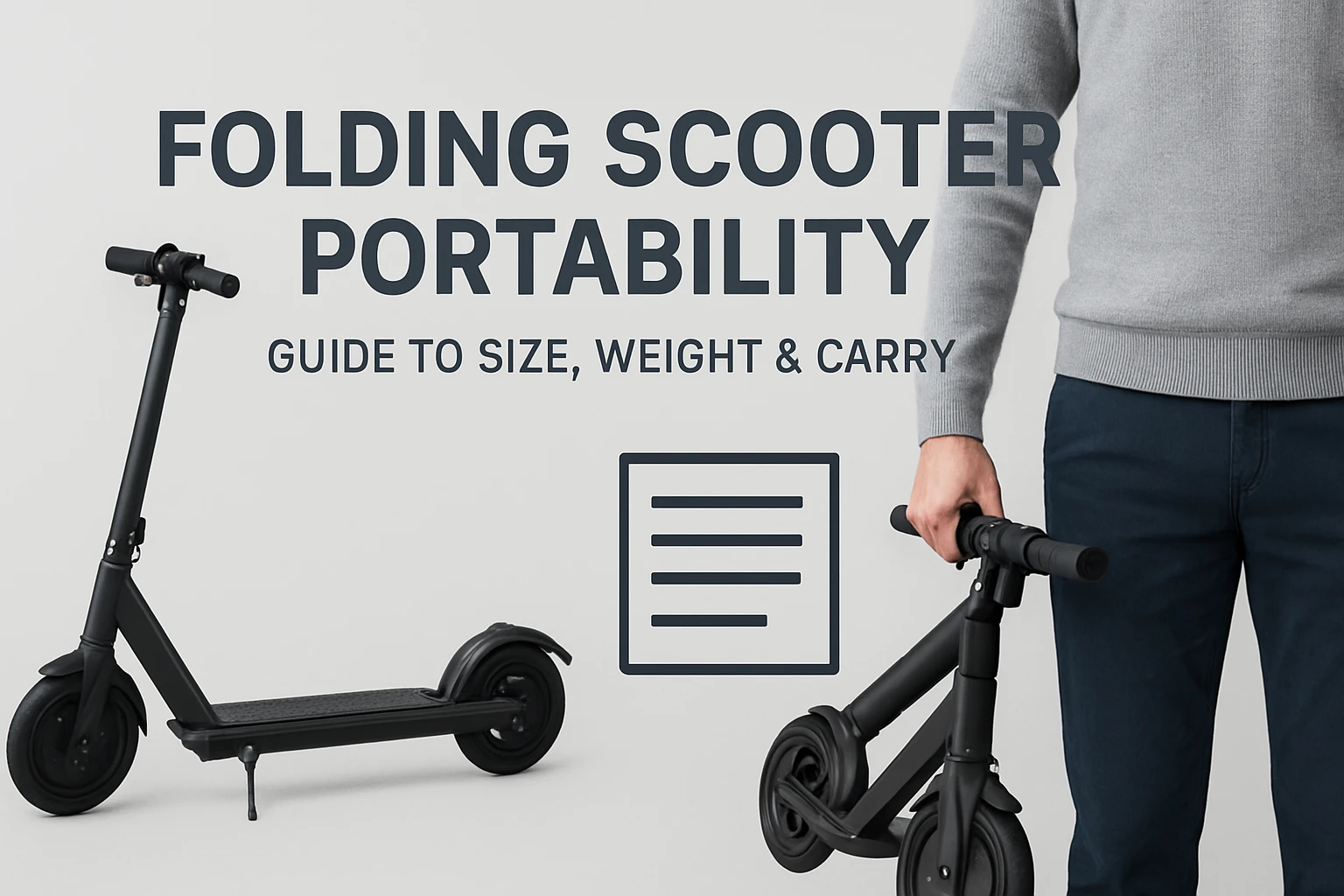
Folding Scooter Portability Explained: Ultimate Guide to Size, Weight & Carry Options
Introduction
Portable personal mobility devices have become essential for urban commuters, college students, and families seeking flexible transportation. This guide explains how to assess the size, weight, and carry options of folding scooters so that readers can make informed purchasing decisions. Readers will learn the technical terminology, practical considerations, and real‑world performance of two popular models: Segway Ninebot E2 Pro and Jetson Jupiter Jumbo. The article also provides a comparison framework, best‑practice tips, and answers to frequently asked questions.
Background / Context
Folding scooters combine the convenience of a lightweight frame with the ability to collapse for storage in a backpack, car trunk, or office closet. The key engineering trade‑offs involve structural rigidity, battery capacity (for electric models), and the folding mechanism itself. Understanding terms such as "folding hinge," "inner hollow tires," and "weight‑to‑power ratio" helps readers evaluate whether a scooter meets their daily commute distance and storage constraints. In addition, safety certifications such as UL 2272 ensure that the electrical system complies with fire‑safety standards, a factor that can influence warranty and insurance considerations.
Understanding Size and Foldability
The overall dimensions of a scooter when unfolded determine its stability, ride comfort, and ability to navigate curbs. A longer deck provides a wider stance, which is beneficial for riders above 180 lb, while a compact deck improves maneuverability in crowded sidewalks. When folded, the length typically reduces to between 30 in and 45 in, allowing the scooter to fit under a standard office desk. The height of the handlebar, often adjustable, influences the ergonomics for riders of different heights.
- Deck length: longer decks improve balance but increase folded size.
- Handlebar range: adjustable ranges from 35 in to 40 in on many models.
- Folded footprint: aim for a folded length under 45 in for most car trunks.
- Weight distribution: balanced weight reduces wobble during folding and unfolding.
Weight Considerations
Weight is a decisive factor for commuters who must carry the scooter up stairs or onto public transportation. The Segway Ninebot E2 Pro weighs approximately 41 lb, providing a solid feel but requiring a two‑hand lift for most adults. In contrast, the Jetson Jupiter Jumbo weighs 9.8 lb, making it easily portable for children and adults alike. When evaluating weight, consider the rider’s strength, the frequency of carrying, and any additional accessories such as helmets or bags.
Manufacturers often use aluminum alloy or magnesium alloy frames to reduce mass while preserving durability. A scooter rated for a maximum load of 198 lb, such as the Segway Ninebot E2 Pro, demonstrates that a heavier frame can still support a wide range of riders without compromising safety.
Carry Options and Accessories
Beyond the basic folding mechanism, many scooters incorporate handles, straps, or dedicated carry bags. A built‑in carry handle simplifies one‑hand lifting, while a detachable strap can secure the scooter to a bicycle rack. Some users add a backpack‑style carrier that distributes weight across the shoulders, reducing strain during long walks. It is advisable to choose a model that includes a lockable hinge to prevent accidental unfolding while in transit.
- Integrated handle: provides a natural grip for quick lifts.
- Removable shoulder strap: useful for multi‑modal trips involving trains or buses.
- Protective travel case: shields the scooter from scratches and impacts.
- Locking mechanism: ensures the scooter remains folded during transport.
Product Recommendations
Segway Ninebot E2 Pro
The Segway Ninebot E2 Pro targets adult commuters who need a blend of range, speed, and durability. Key specifications include a 220 Wh smart battery delivering up to 16 mi in Eco mode and 12 mi in Sport mode, a top speed of 20 mph, and dual elastomer suspension for smoother rides on uneven surfaces. The scooter supports riders up to 198 lb and is UL 2272 & 2271 certified, indicating compliance with rigorous safety standards. At a price of $349.99, it offers a solid value proposition for those who prioritize range and build quality.
- Range: 16 mi (Eco) / 12 mi (Sport)
- Top speed: 20 mph
- Weight: 41 lb
- Load capacity: 198 lb
- Rating: 4.1/5 from 2,369 reviews
Jetson Jupiter Jumbo
The Jetson Jupiter Jumbo is designed for older children and teens who desire a sturdy, lightweight kick scooter. It features 8‑inch wheels, a 6‑inch‑wide deck, and an adjustable handlebar height ranging from 35.6 in to 39.2 in. The scooter folds in half without tools, making it ideal for school lockers or car trunks. Priced at $55.79, it provides an affordable entry point for families while still delivering a smooth ride thanks to shock‑absorbing wheels and a rear foot brake.
- Wheel size: 8 in
- Deck width: 6 in
- Weight: 9.8 lb
- Load capacity: 220 lb
- Rating: 4.3/5 from 1,429 reviews
Comparison / Selection Guide
| Feature | Segway Ninebot E2 Pro | Jetson Jupiter Jumbo |
|---|---|---|
| Primary use | Adult commuting (electric) | Kids & teen recreation (manual) |
| Folded length | ≈ 42 in | ≈ 31.7 in |
| Weight | 41 lb | 9.8 lb |
| Maximum load | 198 lb | 220 lb |
| Battery range | 12‑16 mi | None (manual) |
| Price | $349.99 | $55.79 |
| Average rating | 4.1/5 | 4.3/5 |
When choosing between these models, consider the intended rider, required range, and willingness to manage battery charging. The Segway Ninebot E2 Pro excels for daily commuters who need electric assistance and longer distances, while the Jetson Jupiter Jumbo is ideal for families seeking an affordable, lightweight option for short trips and recreational use.
Best Practices & Tips
To maximize portability, always lock the folding hinge before lifting the scooter. Store the scooter in a dry environment to protect the battery and electronic components from extreme temperatures. When carrying the scooter on public transport, use a shoulder strap or dedicated bag to free the hands for balance. Regularly inspect the folding mechanism for wear, and tighten any loose bolts according to the manufacturer’s maintenance guide.
For electric models, charge the battery to at least 80 % before long trips to ensure optimal performance. Avoid over‑charging beyond the recommended time, as this can reduce battery lifespan. If the scooter includes ambient lighting, such as the chroma lights on the Segway Ninebot E2 Pro, use them responsibly to maintain visibility without draining the battery excessively.
Frequently Asked Questions
- How much weight can a folding scooter typically support? Most adult‑oriented scooters support between 180 lb and 220 lb, while many kids’ models are rated for up to 165 lb. Always verify the manufacturer’s specifications before purchase.
- Can I ride an electric folding scooter in the rain? Models certified under UL 2272 are designed to resist splashes, but riding in heavy rain can still affect traction and battery performance. It is advisable to dry the scooter after exposure.
- What is the average folding time? A well‑designed hinge system allows folding and unfolding within 10‑15 seconds. The Jetson Jupiter Jumbo’s no‑tool folding mechanism typically completes in under 10 seconds.
- Do I need a separate lock for security? Many scooters feature built‑in lockable hinges, but for theft‑prone areas, an additional cable lock provides extra peace of mind.
- How often should I replace the battery on an electric scooter? Battery lifespan varies with usage, but most lithium‑ion packs maintain 80 % capacity for 300‑500 charge cycles, roughly 1‑2 years of daily commuting.
- Is it safe to carry a folded scooter on an airplane? Airlines treat folded scooters as oversized luggage; check carrier policies and consider a protective case to avoid damage.
- Can I adjust the handlebar height on the Segway Ninebot E2 Pro? Yes, the handlebar can be adjusted in small increments to accommodate riders from 14 ft to 6 ft, ensuring ergonomic comfort.
Conclusion
Portability in folding scooters hinges on a balance of size, weight, and carry accessories. By understanding the technical specifications, safety certifications, and real‑world user feedback, readers can select a scooter that aligns with their commuting patterns and storage constraints. Whether the priority is electric range and robust construction, as offered by the Segway Ninebot E2 Pro, or lightweight simplicity for younger riders, as exemplified by the Jetson Jupiter Jumbo, the principles outlined in this guide will lead to a confident purchase decision.
Products Featured in This Guide
Segway Ninebot E2 Pro
Price: $349.99
Rating: 4.1/5 (2,369 reviews)
Featured for its electric range, dual suspension, and UL safety certification, making it a strong choice for adult commuters seeking reliable performance.
Jetson Jupiter Jumbo
Price: $55.79
Rating: 4.3/5 (1,429 reviews)
Featured for its lightweight construction, large 8‑inch wheels, and adjustable handlebar, providing an affordable, portable option for older children and teenagers.