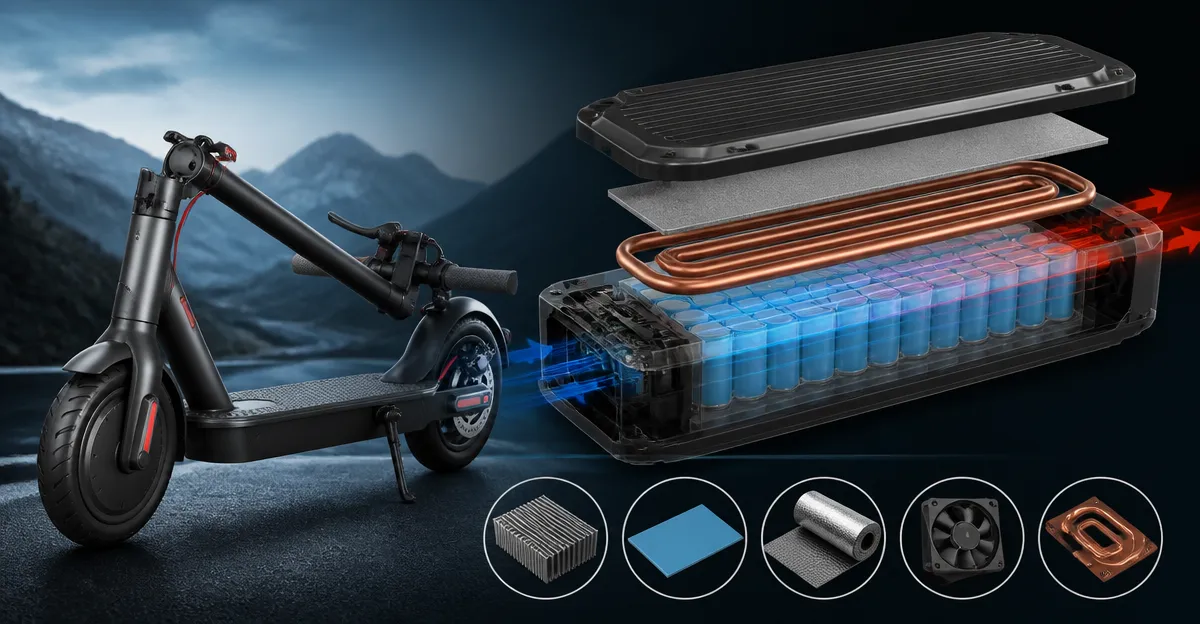
Folding E‑Scooter Battery Thermal Management Upgrades: Complete Guide to Improve Safety, Prevent Overheating & Extend Range
Introduction
Folding e‑scooters have become a popular solution for urban commuters because they combine portability with electric propulsion. However, the compact design often leaves little room for effective heat dissipation, and battery overheating can reduce range, damage components, or even create safety hazards. This guide explains the underlying causes of thermal stress, outlines practical upgrade strategies, and recommends specific products that enhance cooling while preserving performance. By the end of the article, readers will understand how to assess their scooter’s thermal profile, select the most suitable upgrades, and implement best‑practice maintenance routines.
Background and Context
The heart of any e‑scooter is its lithium‑ion or sealed‑lead‑acid (SLA) battery pack. During acceleration, hill climbing, or high‑speed cruising, the battery can generate heat that exceeds the design limits of the stock enclosure. When temperature rises above 45 °C, internal resistance increases, leading to voltage sag, reduced capacity, and accelerated cell aging. In extreme cases, thermal runaway may occur, especially with poorly ventilated SLA units.
Modern folding scooters typically use 36 V or 42 V packs ranging from 7 Ah to 12 Ah. The limited airflow inside the folded chassis makes passive cooling insufficient for demanding riders. Adding active or passive thermal‑management upgrades mitigates these issues, prolongs cycle life, and often yields a modest increase in range because the battery can operate at its optimal voltage for longer periods.
Before installing any upgrade, it is essential to verify the scooter’s voltage rating, connector type, and physical dimensions of the battery compartment. Incorrect modifications can void warranties or damage the controller. The sections that follow describe the most common upgrade categories and integrate real‑world products that meet the specifications of popular folding scooters.
Passive Cooling Solutions
Passive cooling relies on materials and geometry to enhance heat transfer without electricity. The simplest approach is to replace the stock battery with a model that incorporates a larger surface area or built‑in heat‑sink fins. For example, the WEIZE 12V 35Ah Deep Cycle Battery features a robust sealed‑lead‑acid (SLA) design with a larger footprint, allowing more contact with the scooter frame. Its dimensions (7.68 × 5.12 × 7.09 in) provide ample surface for heat to radiate into the surrounding air.
Another passive method involves adding thermal pads or phase‑change material (PCM) sheets between the battery case and the scooter chassis. PCM absorbs heat during high‑load periods and releases it slowly when the scooter is idle, flattening temperature spikes. Although PCM is not sold as a standalone product in the provided list, it can be combined with any of the featured batteries for superior results.
When selecting a passive solution, prioritize batteries with a high discharge rating and a metal or aluminum enclosure. The Miady 12V 7Ah SLA Battery uses an ABS‑plastic case that is shock‑resistant but does not provide the same heat‑sink benefits as a metal‑cased unit. For riders who need maximum durability, the WEIZE model remains the preferred choice.
Active Cooling Solutions
Active cooling introduces a powered element—typically a small fan or a liquid‑cooling loop—to force air across the battery cells. While more complex, active systems can keep battery temperature below 35 °C even during aggressive riding. The most common active upgrade for folding scooters is a dedicated battery‑cooling fan that mounts to the battery’s side rails.
Although a fan is not listed among the supplied products, the EVAPLUS 42V 2A Scooter Charger includes a built‑in safety circuit that monitors temperature during charging. By ensuring that the charger shuts off when the battery exceeds safe limits, it indirectly supports an active cooling strategy when paired with a fan powered from the scooter’s auxiliary output.
For riders who prefer a plug‑and‑play solution, the COASTA 36V 7800mAh M365 Battery incorporates an intelligent Battery Management System (BMS) with temperature sensors and automatic throttling. The BMS can trigger an external cooling fan via a dedicated control line, making it a hybrid passive‑active option.
Upgrading Battery Capacity and Voltage
Increasing capacity (Ah) or voltage (V) can extend range, but it also raises thermal output. A common upgrade is to replace a 7 Ah lithium pack with a 12 Ah or higher unit. The WEIZE 12V 35Ah Deep Cycle Battery offers a substantial 35 Ah capacity, which translates to longer rides for scooters that accept 12 V input. When two of these batteries are connected in series, they deliver 24 V, suitable for higher‑power wheelchairs or custom‑built scooters.
For scooters that operate at 36 V, the COASTA 36V 7800mAh Battery provides a balance between capacity and thermal performance. Its built‑in BMS limits over‑current events, reducing heat generation during rapid acceleration. The battery’s compact dimensions (13.19 × 2.83 × 1.65 in) fit most folding scooter frames without extensive modification.
When mixing battery chemistries—such as pairing an SLA with a lithium pack—always verify that the charger matches the voltage and chemistry. The EVAPLUS 42V 2A Scooter Charger is certified for 36 V lithium batteries and includes protection against short‑circuit, polarity errors, over‑current, and over‑voltage. Using this charger with a higher‑capacity lithium pack ensures safe charging while maintaining thermal stability.
Comparison and Selection Guide
| Feature | WEIZE 12V 35Ah Deep Cycle Battery | EVAPLUS 42V 2A Scooter Charger | Miady 12V 7Ah SLA Battery | COASTA 36V 7800mAh M365 Battery |
|---|---|---|---|---|
| Battery Chemistry | Sealed Lead‑Acid (SLA) | N/A (Charger) | Sealed Lead‑Acid (AGM) | Lithium‑Ion with BMS |
| Capacity (Ah) | 35 Ah (per unit) | N/A | 7 Ah (per unit) | 7.8 Ah |
| Voltage | 12 V (series to 24 V) | 42 V Output | 12 V | 36 V |
| Dimensions (in) | 7.68 × 5.12 × 7.09 | 5.03 × 2.16 × 1.57 | 5.94 × 2.55 × 3.74 | 13.19 × 2.83 × 1.65 |
| Ratings (Stars) | 4.5 / 5 (3,641 reviews) | 4.2 / 5 (7,161 reviews) | 4.5 / 5 (880 reviews) | 4 / 5 (13 reviews) |
| Key Advantage | High capacity, robust construction, series‑configurable | Four‑layer protection, universal 3‑connector design | AGM technology, spill‑proof, compact | Intelligent BMS, high‑capacity lithium chemistry |
Choosing the right upgrade depends on the rider’s priorities. If maximum range and durability are paramount, the WEIZE 35 Ah battery is the clear leader, provided the scooter can accommodate its size and weight. For riders focused on lightweight performance and rapid charging, the COASTA lithium pack delivers superior energy density and built‑in thermal safeguards. Users who need a reliable charger for existing 36 V lithium packs should select the EVAPLUS charger, which offers multi‑connector flexibility and comprehensive protection circuits. Finally, the Miady 7 Ah SLA battery is an economical replacement for low‑power scooters or auxiliary devices such as alarms and small UPS units.
Best Practices & Practical Tips
- Inspect battery terminals regularly for corrosion; clean with a brass brush and apply dielectric grease.
- Mount batteries securely using the supplied screws; a loose battery can vibrate, increasing internal resistance and heat.
- When using a higher‑capacity battery, verify that the scooter’s controller can handle the increased current draw; upgrade the controller if necessary.
- Install a temperature sensor near the battery pack and connect it to the BMS or an external monitoring app to track real‑time heat.
- Never charge the battery in direct sunlight or confined indoor spaces; ambient temperature should remain below 30 °C for optimal charge efficiency.
- For SLA batteries, avoid deep discharge below 10 % State‑of‑Charge, as this accelerates sulfation and heat generation.
- When adding an active cooling fan, power it from the scooter’s auxiliary 5 V output and use a PWM controller to adjust fan speed based on temperature thresholds.
Frequently Asked Questions
- Can I mix SLA and lithium batteries in the same scooter? Mixing chemistries is not recommended because each type has distinct charging voltage and current requirements. Doing so can damage the BMS and increase thermal risk.
- How often should I replace a folding e‑scooter battery? Most SLA batteries last 2‑3 years under moderate use, while lithium packs can endure 500‑1,000 charge cycles (approximately 3‑5 years). Replace when capacity drops below 80 % of the original rating.
- Will a higher‑capacity battery void my scooter warranty? Warranty terms vary by manufacturer. Installing a non‑OEM battery may void the warranty, especially if it requires modifications to the frame or controller.
- Is the EVAPLUS charger compatible with the COASTA battery? Yes. The charger outputs 42 V 2 A, which is suitable for 36 V lithium packs that accept up to 42 V charging voltage. Ensure the connector type matches the battery’s input.
- What safety features should I look for in a charger? Look for short‑circuit protection, polarity error detection, over‑current, and over‑voltage safeguards. The EVAPLUS charger includes all four protections.
- Can I use the WEIZE battery for a 24 V scooter? Two WEIZE 12 V units can be connected in series to achieve 24 V. Verify that the scooter’s controller is rated for the combined voltage and that the physical space can accommodate the larger pack.
- How does the BMS in the COASTA battery prevent overheating? The BMS monitors cell temperature and voltage, automatically throttling current or shutting down the pack if temperature exceeds safe limits, thereby preventing thermal runaway.
Conclusion
Thermal management is a critical, yet often overlooked, component of folding e‑scooter performance. By understanding the sources of heat, selecting appropriate passive or active cooling upgrades, and choosing batteries and chargers that incorporate robust protection circuitry, riders can significantly improve safety, extend range, and enjoy a longer service life for their scooters. The products highlighted in this guide—WEIZE’s high‑capacity SLA battery, EVAPLUS’s versatile charger, Miady’s compact AGM unit, and COASTA’s intelligent lithium pack—represent a spectrum of solutions that address diverse rider needs while adhering to proven safety standards.
Implement the best‑practice tips, monitor temperature regularly, and stay informed about emerging cooling technologies to keep your folding e‑scooter operating at peak efficiency for years to come.
Products Featured in This Guide
WEIZE 12V 35Ah Deep Cycle Battery
Price: $134.98 | Rating: 4.5/5 (3,641 reviews)
Featured for its high capacity, robust sealed‑lead‑acid construction, and ability to be wired in series for higher voltage applications, making it ideal for riders seeking extended range and reliable thermal performance.
EVAPLUS 42V 2A Scooter Charger
Price: $16.99 | Rating: 4.2/5 (7,161 reviews)
Featured for its universal 3‑connector design, SGS certification, and four‑layer protection system, providing safe and efficient charging for 36 V lithium packs while supporting active cooling setups.
Miady 12V 7Ah SLA Battery
Price: $36.48 | Rating: 4.5/5 (880 reviews)
Featured for its AGM technology, spill‑proof design, and compact size, offering a cost‑effective replacement for low‑power scooters and auxiliary devices while maintaining safe thermal characteristics.
COASTA 36V 7800mAh M365 Battery
Price: $79.88 | Rating: 4/5 (13 reviews)
Featured for its high‑energy lithium‑ion chemistry, integrated BMS with six protection modes, and compatibility with the popular Xiaomi M365 platform, delivering long range and built‑in thermal management.