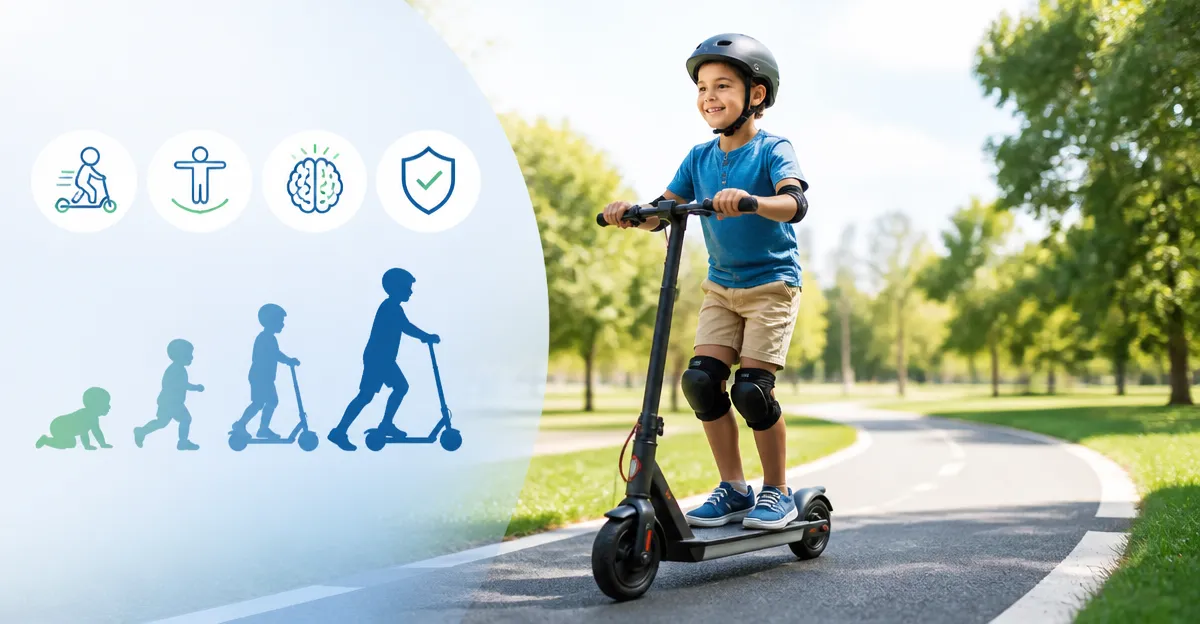
E‑Scooters for Kids: The Ultimate Parent’s Guide to Motor Development Benefits, Skills & Safety
Introduction
This guide explains how electric scooters designed for children support physical development, improve coordination, and provide safe outdoor recreation. Parents will learn the underlying motor‑skill concepts, discover age‑appropriate features, and receive actionable safety advice. The article also highlights five highly rated models that exemplify best‑in‑class design, performance, and value.
By the end of the reading, caregivers will be equipped to select a scooter that matches a child’s size, ability, and interests while fostering confidence and balance.
Background and Context
Motor development in early childhood follows a predictable sequence: gross‑motor abilities such as walking, running, and jumping emerge before fine‑motor control of the hands. Riding a scooter integrates both domains because it requires core stability, lower‑body strength, and precise hand‑eye coordination.
Research indicates that activities involving dynamic balance improve proprioception, which is the body’s awareness of its position in space. Proprioceptive training reduces the risk of falls and enhances athletic performance later in life. Scooters that incorporate lean‑to‑steer technology encourage children to shift weight naturally, reinforcing these pathways.
Modern kids’ scooters often include LED lighting, adjustable handlebars, and lightweight frames. These features address safety, ergonomic growth, and the desire for engaging visual feedback, making scooters an attractive tool for developmental play.
Key Concepts for Parents
1. Balance and Core Activation
When a child leans to turn, the scooter’s three‑wheel or two‑wheel geometry forces the rider to engage abdominal and back muscles. This activation promotes a stronger core, which underpins posture and reduces the likelihood of spinal strain during other activities.
Products such as the Gotrax KS1 Kids Scooter feature lean‑to‑steer technology and a wide anti‑slip deck, providing a stable platform for novice riders.
2. Coordination and Timing
Coordinating push‑off, steering, and braking requires split‑second timing. Repetitive practice on a scooter refines neural pathways that control limb synchronization, which translates to improved performance in sports such as soccer, basketball, and gymnastics.
The Razor A Kick Scooter offers a rear‑fender brake and smooth urethane wheels that allow children to experiment with stopping distance safely.
3. Visual Feedback and Motivation
LED‑lit wheels create a visual cue that reinforces movement. Children receive immediate feedback when speed increases, encouraging them to maintain a steady pace while staying visible in low‑light conditions.
Both the Jetson Jupiter Kids Scooter and the Hurtle 3‑Wheel Kids Scooter incorporate multi‑color LED wheels that delight children and alert drivers.
4. Adjustable Ergonomics
Children grow quickly; a scooter that adapts to height changes extends its usable lifespan. Adjustable handlebars allow the rider to maintain a comfortable arm angle, reducing strain on shoulders and wrists.
The besrey 3‑Wheel Scooter provides four height settings, ensuring a proper fit from ages three through ten.
Product Recommendations Integrated with Developmental Benefits
Gotrax KS1 Kids Scooter
- LED‑lighted wheels for night‑time visibility and excitement.
- Lean‑to‑steer technology that encourages natural balance development.
- Three adjustable handlebar heights (33.7/31.9/29.9 inches) to grow with the child.
- ABEC‑7 bearings and a 5‑inch anti‑slip deck for smooth rides on uneven surfaces.
- Weight: 5.1 lb; maximum load: 110 lb; rating 4.6/5 from 7,829 reviews.
Razor A Kick Scooter
- Lightweight aluminum frame (approximately 7 lb) for easy transport.
- Original folding mechanism for compact storage.
- Adjustable handlebars for customizable height.
- Rear‑fender brake and durable urethane wheels for safe stopping.
- Rating 4.8/5 from 33,738 reviews; price $29.97.
Jetson Jupiter Kids Scooter
- Over 100 LED lights on wheels, stem, and deck for vibrant illumination.
- Low‑deck design and 4‑inch shock‑absorbing wheels for stability.
- Adjustable handlebar range 24.6‑33.3 inches, supporting growth.
- Foldable, under‑7‑lb weight, and a rear foot brake for quick stops.
- Supports riders up to 132 lb; rating 4.5/5 from 24,236 reviews.
Hurtle 3‑Wheel Kids Scooter
- Three‑wheel lean‑to‑steer system with multi‑color LED wheel lights.
- Removable flip‑out seat for ages 1‑14, expanding usage scenarios.
- Four handlebar height options (25.5‑34 inches) for a broad age range.
- Wide anti‑slip deck and 120 mm/80 mm gliding rollers for smooth motion.
- Rating 4.6/5 from 20,865 reviews; price $54.99.
besrey 3‑Wheel Scooter
- Extra‑wide anti‑slip deck with a load capacity of 110 lb.
- LED PU wheels that brighten with speed, providing visual safety.
- Lean‑to‑steer technology for balance training.
- One‑step folding design, no assembly required.
- Rating 4.8/5 from 3,631 reviews; price $62.98.
Comparison and Selection Guide
| Feature | Gotrax KS1 | Razor A | Jetson Jupiter | Hurtle 3‑Wheel | besrey 3‑Wheel |
|---|---|---|---|---|---|
| Price (USD) | $34.19 | $29.97 | $29.99 | $54.99 | $62.98 |
| Weight | 5.1 lb | ~7 lb | 6.2 lb | ~9 lb | ~8 lb |
| Max Load | 110 lb | 130 lb | 132 lb | 132 lb | 110 lb |
| Wheel Count | 3 (LED) | 2 (urethane) | 2 (LED) | 3 (LED) | 3 (LED) |
| Adjustable Handlebar | 3 heights | Yes | 4 heights | 4 heights | 4 heights |
| Foldable | Yes | Yes | Yes | Yes (seat removable) | Yes (one‑step) |
| Rating | 4.6/5 | 4.8/5 | 4.5/5 | 4.6/5 | 4.8/5 |
When choosing a scooter, parents should prioritize safety features such as reliable brakes and anti‑slip decks, then consider developmental attributes like lean‑to‑steer and adjustable height. Budget constraints and intended usage (park vs. indoor) also influence the decision.
Best Practices & Tips for Safe Riding
- Inspect the scooter before each use; verify that wheels spin freely and brakes engage promptly.
- Require the child to wear a properly fitted helmet, knee pads, and elbow pads.
- Establish a riding zone free of traffic, potholes, and steep inclines.
- Teach the lean‑to‑steer technique on flat ground before attempting turns at speed.
- Encourage regular breaks to prevent fatigue, which can impair balance.
- Maintain the scooter by tightening bolts, cleaning bearings, and charging LED batteries as needed.
- Model the behavior; demonstrate safe boarding, dismounting, and braking.
Frequently Asked Questions
What age is appropriate for a three‑wheel scooter?
Three‑wheel designs are ideal for children as young as two years because the wide base offers inherent stability. Models such as the Hurtle 3‑Wheel Kids Scooter support riders from 1 year up to 14 years, making them a long‑term investment.
Do LED lights affect battery life?
Most kids’ scooters use rechargeable lithium‑ion cells that power LED arrays for several hours of continuous use. The lights are typically motion‑activated, conserving energy when the scooter is stationary.
How can I ensure the scooter fits my child’s height?
Measure the child’s inseam and compare it to the scooter’s deck height. The handlebar should allow the child to stand with elbows slightly bent. Adjustable‑height models such as the besrey 3‑Wheel Scooter provide a range of settings to accommodate growth.
Is a rear‑foot brake sufficient for safety?
A rear‑foot brake is standard on most children’s scooters and provides reliable stopping power when the rider presses down with the foot. Parents should supervise initial use to ensure the child understands the pressure needed for a smooth halt.
Can these scooters be used on rough terrain?
Three‑wheel scooters with larger pneumatic or foam‑filled wheels, such as the Gotrax KS1, handle uneven surfaces better than two‑wheel models. However, for off‑road use, a scooter specifically marketed for all‑terrain should be selected.
Conclusion
Kids’ e‑scooters are more than a recreational toy; they are a developmental tool that strengthens core muscles, refines coordination, and builds confidence. By selecting a model with safety‑first features, adjustable ergonomics, and engaging LED feedback, parents can provide a secure platform for growth.
Remember to enforce protective gear, establish clear riding boundaries, and perform routine maintenance. With these practices, a scooter can become a lifelong companion that encourages active play and motor‑skill mastery.
Products Featured in This Guide
Gotrax KS1 Kids Scooter
Price: $34.19 | Rating: 4.6/5 (7,829 reviews)
Featured for its lean‑to‑steer technology, LED wheels, and adjustable handlebar heights that support balance development.
Razor A Kick Scooter
Price: $29.97 | Rating: 4.8/5 (33,738 reviews)
Featured for its ultra‑light aluminum frame, reliable rear‑fender brake, and classic folding mechanism that encourages independent transport.
Jetson Jupiter Kids Scooter
Price: $29.99 | Rating: 4.5/5 (24,236 reviews)
Featured for its extensive LED lighting system, low‑deck stability, and foldable design that makes it ideal for indoor and outdoor play.
Hurtle 3‑Wheel Kids Scooter
Price: $54.99 | Rating: 4.6/5 (20,865 reviews)
Featured for its convertible seat, multi‑color LED wheels, and four‑position handlebar that accommodates a broad age range.
besrey 3‑Wheel Scooter
Price: $62.98 | Rating: 4.8/5 (3,631 reviews)
Featured for its extra‑wide anti‑slip deck, motion‑activated LED wheels, and one‑step folding mechanism that requires no assembly.